My yearly electricity use is
Your yearly electricity use helps us size your solar panel system.
Panel brands UK installers often fit include





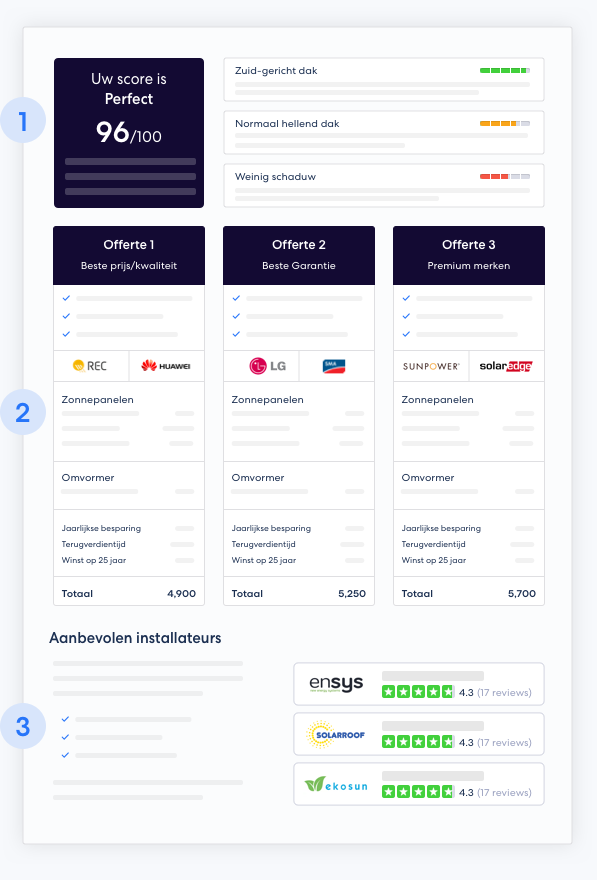
What you get after the calculation
In a few minutes you get a solar report for your home. Not national averages, but a calculation for your address, your roof and your electricity use.
A design for your roof
See how many panels fit on your roof and how much electricity they should generate in a year. Where roof data exists for your address, the calculator uses the direction, pitch and space of each roof face, with PVGIS sunshine data for your location.
Price, savings and payback
You get an estimated installed price, your yearly savings and the payback time, with and without a battery. You can change the assumptions and see the effect straight away.
Real prices from installers near you
Compare our estimate side by side with installers near you and ask up to three of them for their price, line by line, free and with no obligation. Installers don’t see your contact details until you choose one.
Choosing an installer
What to check before you commit
Compare the equipment
Check the brand, model and warranties of the equipment offered.
Check the work included
See which work, paperwork and registrations each quote covers.
Look at the company
Check its experience, references and the reviews available.
And anything specific to your home

A detailed quote showing every cost and the VAT

The installer’s experience and qualifications

References from similar installations

MCS certification, consumer-code membership and insurance

Availability in your area

Aftercare, servicing and warranties


Installers you can ask for a price
Local solar installers from our directory
They price your roof line by line, with their own equipment
No installer pays for their place
Calculator questions
It is as accurate as its inputs. PVGIS generation is a long-term average that varies from year to year, and the biggest uncertainties are how much solar power you'll use, your export rate and your installed price. Enter your own usage and tariff to narrow the range.
Mostly because of the export rate, the daytime-at-home assumption and the date of the prices. Some calculators assume 12p or more for exports without saying that it usually means buying your electricity from the same supplier; we show 12p with that condition and 6p beside it.
Each kWh your panels produce while the house is using power is a kWh you don't buy, so it saves your unit rate (26.32p/kWh at the Ofgem cap, October to December 2026). The standing charge stays. Exported electricity is paid for separately by your export supplier, from export meter readings. Bills fall most in summer.
No. MCS installers work out generation with MCS's own irradiance tables and must use MCS self-consumption tables. Our use-at-home estimate is matched to those tables, but generation comes from PVGIS, and with a 5 kWh battery our share of solar used at home averages 4 to 9 points above the MCS table. The installer's written estimate is the one to rely on in a contract.