
Reading time: 12 min
Microinverters vs string inverters
A practical comparison of string inverters, power optimisers and microinverters for UK homes.
Read more
APsystems makes microinverters that each serve two or four panels. On a UK roof, the DS3's pairing, the G98 limit and a warranty that depends on staying online matter more than the brand name.
 China
China
 Founded 2010
Compare the specifications and warranties of the exact model.
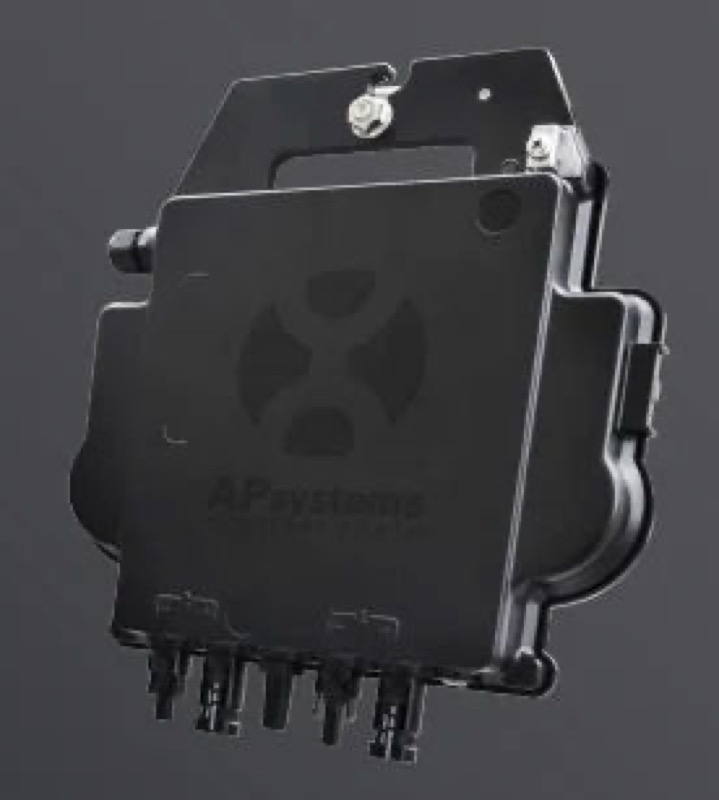
APsystems makes microinverters that sit under the panels and each serve more than one of them: the DS3 handles two panels, with a separate tracker for each. They suit roofs where panels face different ways or catch shade at different times, and APsystems lists several UK distributors. APsystems' EMEA warranty gives the DS3 12 years as standard, extendable to 25, but only while the system stays connected to the internet through APsystems' gateway; otherwise cover drops to two years. APsystems also has two plug-in solar kits on the ENA register, and an EZ1 microinverter designed for balconies and DIY set-ups.
If you are still deciding between microinverters and a single string inverter, start with our microinverters vs string inverters comparison.
The DS3 is a single-phase microinverter for two panels. APsystems' EMEA datasheet (Rev 1.7, January 2025) gives it two input channels, each with its own MPPT, a tracker that finds the best operating point for the panel connected to it. The DS3 comes in three output ratings: 730 VA (DS3-L), 880 VA (DS3) and 960 VA (DS3-H). Check which one your quote names, because the rating decides how many panels each unit suits and how many units your grid connection allows.
Your yearly electricity use helps us size your solar panel system.
The QT2 is a three-phase unit for four panels, rated at 2,000 VA. APsystems describes it as having four input channels but two MPPTs, so two pairs of panels share a tracker. It suits a home with a three-phase supply, and the pairs should face the same way and get similar shade.
| Check | DS3 | QT2 |
|---|---|---|
| Panels per unit | 2 | 4 |
| Grid connection | Single-phase | Three-phase |
| Independent trackers | 2 (one per panel) | 2 (one per pair) |
| What to ask | Which rating (730, 880 or 960 VA), and whether the panels suit it | Which panels share a tracker, and why |
The ENA's type-test register lists the DS3, DS3-L and DS3-H as Compliant for G98 and G99 in Great Britain since March 2022, with separate Northern Ireland records, and the QT2 since July 2024.
In Great Britain, on a normal single-phase supply, G98 lets your installer connect first and notify your network operator within 28 days, as long as the total inverter output is no more than 3.68 kW. With microinverters, that total is the sum of every unit on the roof.
Example: ten 450 W panels (4.5 kWp) on five DS3 units at 880 VA each add up to 4.4 kVA (5 × 0.88). That is above 3.68 kW, so your installer must apply under G99 and get approval before connecting. Four DS3 units would be 3.52 kVA, within G98, but would serve only eight panels. Neither choice is wrong: G99 adds weeks and sometimes conditions, while fewer or lower-rated units may clip output on the sunniest days. Ask your installer which route your quote assumes. Our G98 and G99 guide explains the process.
The datasheet also limits how many units can share one AC branch cable: five DS3 on 2.5 mm² cable, for example. That is the installer's design job, but the circuit layout should appear on your quote.
Two trackers per DS3 mean each panel works independently, which helps when one panel is shaded by a chimney in the morning or faces east while its neighbour faces west. The benefit is real only if the panels suit the DS3's input limits: the datasheet recommends panels of 300 to 620 W for the standard DS3, with a maximum input current of 20 A per channel.
Ask for a layout that shows each panel, the unit and input it connects to, and the AC circuits. With a QT2, ask which panels share a tracker; if an installer says a QT2 has four independent trackers, ask for the datasheet, because APsystems says it has two. The layout also helps later: if the monitoring shows one panel underperforming, you can find it on the roof.
APsystems' monitoring uses an ECU gateway in your home, which collects data from the microinverters over encrypted Zigbee radio and sends it to APsystems' EMA platform. For a roof system, APsystems says the EMA account must be created by an installer.
That monitoring is also a warranty condition. APsystems' Microinverter Limited Warranty for Europe, the Middle East and Africa (edition 08/25, for products installed and registered from 1 January 2025) says:
The practical point: a microinverter sits under a panel, so a warranty replacement may need roof access or scaffolding that nobody's warranty covers. Ask your installer in writing who pays for that. Keep the ECU plugged in and on your router, and check the app now and then; our solar panel monitoring guide explains what to look for, and our guide to solar panel warranties explains how manufacturer and installer cover differ.
The EZ1 is APsystems' microinverter for balcony and DIY systems: two panels, Wi-Fi and Bluetooth, and an app called AP EasyPower. APsystems' EZ1 product page says the EZ1 is not suitable for rooftop use and that its warranty is void if it is installed on a roof. APsystems gives it a 12-year warranty, but only if you register it in the AP EasyPower app; otherwise APsystems' own cover is 2 years from shipment.
APsystems' plug-in kits are retail kits you set up yourself. Under the plug-in solar rules in force in Great Britain since 27 August 2026, what counts is the complete kit, not the microinverter alone. It must have an output of no more than 800 W, have no battery and appear on the ENA register under the "Plug-in Solar" type. When we checked on 24 September 2026, the register listed two APsystems kits, both marked Compliant: "Premium Set Dual-1020W-Full black" (0.799 kW, published 2 September 2026) and "Premium Set Single-510W-Full black" (0.5 kW, published 7 September 2026). An EZ1 bought on its own and paired with other panels is not one of these listed kits. Buy from an APsystems-authorised seller: the warranty excludes products bought on an unauthorised third-party online platform. Mount the panels where you can reach them safely without working at height; throughout Great Britain the government's plug-in specification forbids fixing a kit to a timber balcony or to cladding made of timber, metal composite or laminate, and English planning rules also exclude any wooden wall, balcony, fence or enclosure.
The usual plug-in limits apply: one device per household until the G98 rules are amended, notification to your network operator, 20% VAT on a kit bought from a shop, and Great Britain only. In Great Britain, Smart Export Guarantee (SEG) payments come from each supplier's own SEG tariff and need MCS or equivalent certification; plug-in kits have no established route to them. APsystems has also shown an EZHI hybrid microinverter with storage for DIY systems; plug-in kits with a battery are outside the plug-in rules. Our plug-in solar guide covers the rest.
APsystems lists no UK office. Its European company is in Amsterdam, and technical support runs through support.emea@apsystems.com. APsystems lists UK distributors including UKSOL, HDM Solar, Solar Trade Sales, UK Greentech and Solar Surfer. For a roof system, your installer is your first contact for faults and warranty claims; for a plug-in kit, it is the shop that sold it.
With a roof system, the installer supplies and fits everything, so under the Consumer Rights Act 2015 the installer is responsible if the microinverters are faulty or badly fitted, alongside APsystems' warranty. Because the APsystems warranty depends on EMA registration and a continuous connection, ask your installer to:
If the installer later stops trading, having your own EMA access and serial numbers makes a claim far easier. In Great Britain, MCS (or equivalent) certification is needed for Smart Export Guarantee payments, but it doesn't include consumer-code membership, so check the installer on the RECC or HIES register if deposit protection matters to you. Our guide to comparing solar quotes lists what else a quote should include.
For a plug-in kit bought from a shop, your rights are against the retailer, and online purchases carry a 14-day right to cancel from delivery. Register the EZ1 in the app straight away to keep the full warranty.
Our view: APsystems is a sensible choice for roofs with mixed orientation or partial shade, provided the quote shows the pairing, the G98 or G99 route and the EMA set-up. The 12-year warranty is solid on paper; it is worth the full term only if your system stays online.
12 years under APsystems' EMEA warranty, extendable to 25 if you buy the extension within 6 months of EMA registration. If the microinverters are not kept connected to the internet through the ECU, APsystems' own cover drops to 2 years; your statutory rights against the installer are separate.
Yes. Each DS3 has two inputs, each with its own tracker. The QT2 has four inputs but two trackers.
Only as part of a complete kit on the ENA register under "Plug-in Solar". On 24 September 2026, two APsystems "Premium Set" kits were listed as Compliant. APsystems says the EZ1 must not be installed on a roof.
No. Like other grid-connected inverters, they switch off when the grid fails. Monitoring through EMA does not provide backup power.
Tell us about your home and we’ll look for an MCS-certified installer who can quote.
 No cost and no obligation
MCS-certified installers
One short request
We currently receive no payment from installers, or from anyone else, for quote requests.
 Get quotes: APsystems
We currently receive no payment from installers, or from anyone else, for quote requests.