
Reading time: 12 min
Microinverters vs string inverters
A practical comparison of string inverters, power optimisers and microinverters for UK homes.
Read more
Enphase puts a microinverter behind every panel and sells an AC battery built the same way. The UK warranty is long, but it depends on the system staying online and on where you live.
 United States
 3,000+ employees
 Founded 2006
Compare the specifications and warranties of the exact model.
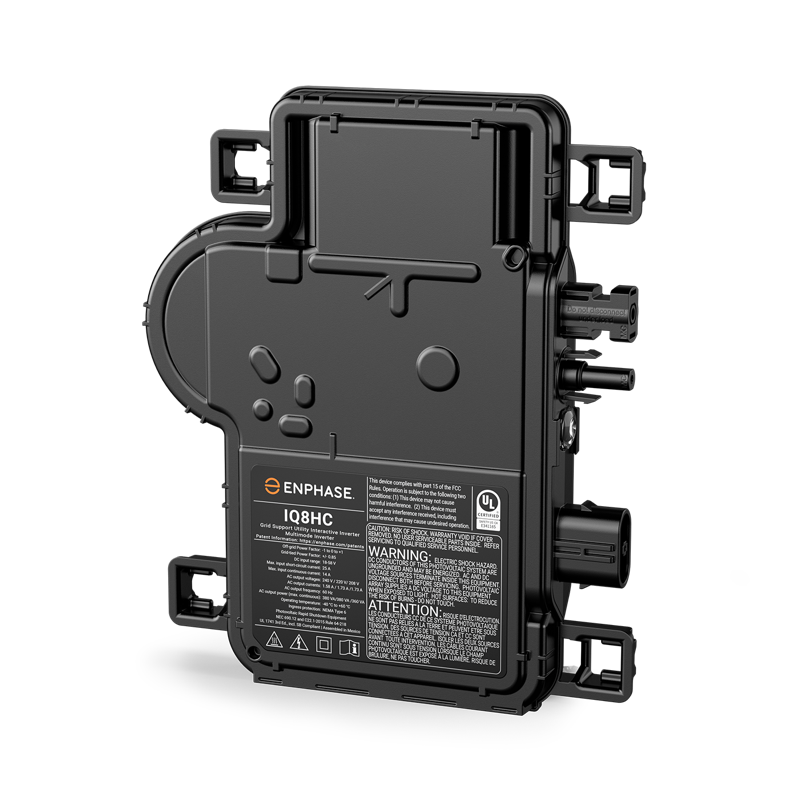
Enphase is worth comparing if your roof faces more than one way, has some shade, or you want to see how every panel performs. Each panel gets its own IQ8 microinverter, which turns its output into mains electricity on the roof. That gives flexibility on awkward roofs, but it puts one electronic device under each panel, so the cost of a repair and the terms of the warranty matter more than with a single inverter on a wall. Enphase's UK warranties give 25 years on IQ8 microinverters and 15 years on the IQ Battery 5P, but they depend on the system staying connected to the internet through an Enphase IQ Gateway, and the UK documents cover England, Scotland and Wales.
Enphase sells in the UK through distributors such as Segen, Midsummer Wholesale and UK Greentech, and its UK warranties list a UK support line. Octopus Energy's own solar packages include Enphase systems, so if you have an Octopus quote, you may already have an Enphase quote.
A string inverter handles the output of a whole row of panels in one box. With Enphase, the IQ8 microinverter under each panel does that conversion for one panel only. If a chimney shades one panel in the afternoon, the others carry on at their own output. That helps on roofs with two or three faces, dormers or partial shade, but it doesn't remove the loss on the shaded panel itself. Our guide to microinverters and string inverters compares the designs, and our shading guide explains when shade really costs you output.
Your yearly electricity use helps us size your solar panel system.
The microinverters are only part of the system. A complete Enphase quote also includes the IQ Gateway (the box that collects data and sends it to the Enphase App), the current clamps that measure what your home uses, the cabling on the roof and the protection in your consumer unit. Without the consumption clamps, the app can show what the panels make but not how much of it your home uses. Ask for the Gateway model and the clamps by name on the quote.
Enphase's UK datasheet for the three main IQ8 models (March 2026 edition) gives these continuous AC ratings:
| Model | Rated AC output | Question for your installer |
|---|---|---|
| IQ8MC-72-M-INT | 325 W | Is it matched to the panel's voltage and current in cold and hot weather? |
| IQ8AC-72-M-INT | 360 W | What yearly output does the design show with this panel? |
| IQ8HC-72-M-INT | 380 W | Does this roof need the larger model, or would a smaller one do? |
A panel rated at 450 W on a 380 W microinverter isn't necessarily a design mistake. A panel reaches its full rating only in bright, cool conditions, so the microinverter caps output only in the brightest hours. The installer should show that the pairing passes Enphase's compatibility calculator and what the capping costs over a year in kWh.
G98 or G99. In Great Britain, a home on an ordinary single-phase supply can connect up to 3.68 kW of generation under G98: the installer fits the system and then notifies the network operator within 28 days (30 days in Northern Ireland under G98/NI). With microinverters, that limit applies to the combined rating of all the units, plus any battery. Above it, your installer has to apply under G99 and get the network operator's approval before connecting; a battery's 3.2 kVA takes the total above 3.68 kW on most systems.
On the ENA type-test register (checked 24 September 2026), the Compliant records for Great Britain for these three IQ8 models and the single-phase IQ Battery 5P are G99 records; their Compliant G98 records cover Northern Ireland. Ask your installer which register listing covers the exact model codes they will fit, and whether your system will need a G99 application.
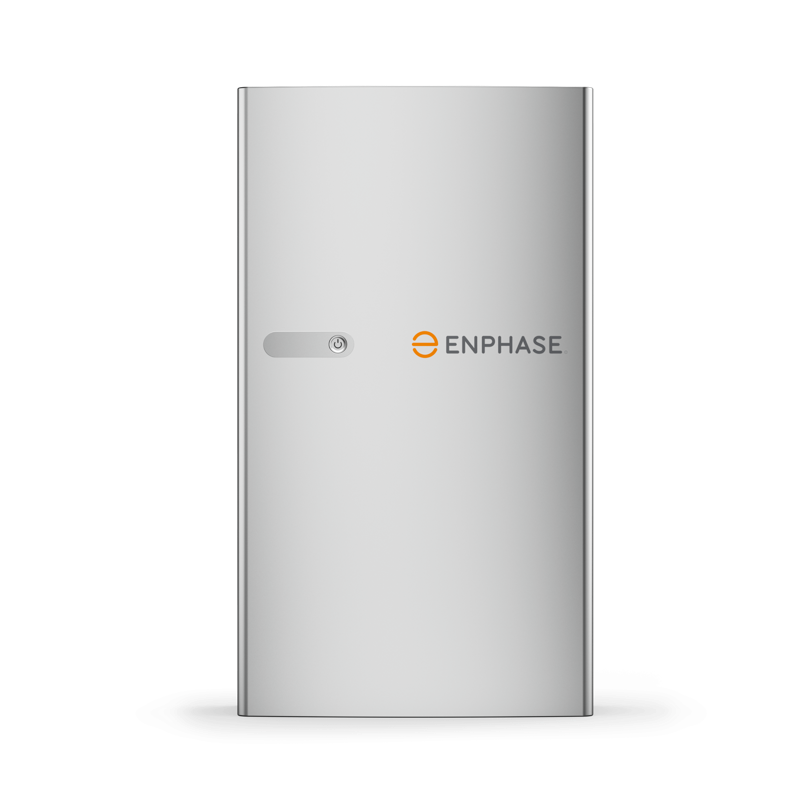
The IQ Battery 5P stores 5.0 kWh of usable energy per unit. It is AC-coupled: six small microinverters inside the battery convert its power, so it connects to your home's AC wiring rather than to the panels. Enphase's Great Britain datasheet gives 3.2 kVA continuous power per unit and 90% round-trip efficiency from AC to AC. Two units give 10 kWh and 6.4 kVA.
Because it is AC-coupled, the 5P can also be added to an existing Enphase system, but not in every combination. Enphase's March 2026 IQ8 datasheet lists the set-ups in which older IQ7 and newer IQ8 equipment can share one Gateway, and says IQ7 units can't be added to a site that already has IQ8s. If your system is a few years old, ask the installer to check your Gateway, firmware and microinverter models against that list before quoting.
A battery moves electricity from one part of the day to another; it doesn't make more. Example (illustrative): a household using about 2,500 kWh a year might use 4 kWh between sunset and bedtime. On a spring day with 6 kWh of spare solar, one 5P can fill and cover most of that evening. On a grey winter day with 1 kWh spare, it can store only that 1 kWh from the sun, whatever its size. Homes with an electric car or a heat pump, or on a cheap overnight tariff, get more from a second unit, because they can fill it from the grid at night. Our guide to solar battery storage explains how to size one from your own figures.
In a power cut, an ordinary grid-connected solar system switches off to keep the network safe for engineers, and a battery on its own doesn't change that. In the UK, Enphase backup needs the IQ System Controller 3 INT, which detects the outage, disconnects your home from the grid and switches it to battery power. The single-phase 5P on its own supports self-consumption and charging from the grid; backup comes from the controller.
Ask the installer which circuits the controller will keep on (for example the fridge, lights, broadband and a few sockets), how much power is available at once, what reserve stays in the battery for a power cut, and what happens when the battery runs flat. An electric shower or a heat pump can need more power than one 3.2 kVA unit gives. Ask to see the changeover tested at handover; don't work on the consumer unit yourself.
Enphase publishes separate UK warranties by product and by activation date. For microinverters, the Gateway and clamps activated from 30 September 2025 the document is LGL-00070 v3.0; for batteries and the System Controller activated from 15 September 2025 it is LGL-00097 v2.0:
| Part | Warranty from activation |
|---|---|
| IQ8 and IQ7 microinverters | 25 years |
| IQ Gateway and consumption clamps | 5 years |
| IQ System Controller | 10 years |
| IQ Battery 5P | 15 years or 6,000 cycles, whichever comes first |
The battery warranty also promises at least 70% of the rated capacity at 10 years and 60% at 15 years.
The conditions matter as much as the numbers:
Enphase repairs or replaces the part, or refunds its current value. Its warranty doesn't pay for work on your electrical system, and replacing a microinverter means going back on the roof. Enphase runs a separate scheme that pays installers who don't buy directly from Enphase a fixed contribution towards labour for replacements in the first two years of the warranty, which may not cover the cost of scaffolding. Ask your installer who pays for access if a microinverter fails in year 8.
Ask for a quote that lists:
Solar panels and batteries supplied and installed in your home are zero-rated for VAT until 31 March 2027, then 5% unless the relief is extended; kit bought without installation is charged at 20%. In Great Britain, an Enphase system earns export payments through an energy supplier's own Smart Export Guarantee tariff, at that supplier's rates and conditions, and only if the installation holds MCS certification (or equivalent); Northern Ireland has no SEG. MCS's product directory lists panels and mounting kits, not microinverters or batteries, so check the installer's MCS certificate instead.
Enphase's UK warranty spells this out: under the Consumer Rights Act 2015, putting a faulty product right is first the job of the business that sold it to you. For an Enphase system that is usually your installer, who also holds the design and the roof work. So pick one you expect to be around in ten years, and check whether they belong to RECC or HIES, because MCS certification alone no longer guarantees consumer-code protection such as an insurance-backed workmanship warranty. Our guides to comparing solar quotes and choosing an installer go through the paperwork.
Our view: Enphase earns its place on roofs with several faces or shade, and for buyers who want panel-level data and a battery that can be added later. On a simple roof, compare it with a string or hybrid inverter quote for the same panels, and if you're considering Octopus, our Octopus solar panels review covers its packages.
No. Each microinverter works on its own panel, so the rest carry on at their own output. The shaded panel still produces less, so moving it or leaving that spot empty can be the better design.
Often, but not always. The 5P is AC-coupled, so it doesn't need the panels rewired, but Enphase allows older IQ7 and newer IQ8 equipment on one Gateway only in the set-ups it lists. Ask the installer to check your Gateway, firmware and microinverter models first.
No. It applies to IQ8 microinverters in England, Scotland and Wales while the system stays online through an IQ Gateway, and the system must be registered within 45 days of activation. The Gateway itself has 5 years.
Only with an IQ System Controller 3 INT fitted and wired for backup. Ask which circuits it covers and see it tested at handover.
Tell us about your home and we’ll look for an MCS-certified installer who can quote.
 No cost and no obligation
MCS-certified installers
One short request
We currently receive no payment from installers, or from anyone else, for quote requests.
 Get quotes: Enphase
We currently receive no payment from installers, or from anyone else, for quote requests.