
Reading time: 8 min
Solar panel sizes and weights
The size and weight of four current home solar panels, read from their datasheets, and how to turn those numbers into panels, kWp and a layout that fits your roof.
Read more
AIKO's back-contact Neostar panels put a lot of power into a standard-size panel. The model code on your quote decides the size, the construction and whether the product warranty is 25 or 30 years.
 China
China
 7,000+ employees
 Founded 2009
Compare the specifications and warranties of the exact model.
AIKO is a panel brand worth shortlisting if your roof is small, awkwardly shaped or on show, because its back-contact Neostar panels fit a lot of power into a standard-size panel and have no metal lines across the front. Whether an AIKO quote is good value depends on the exact model code: two Neostar panels with almost the same name can come with a 25-year or a 30-year product warranty. AIKO has a UK company, AIKO ENERGY UK CO., LTD in Birmingham, and its panels are in the MCS product directory, so you can look up the code on your quote before you sign.
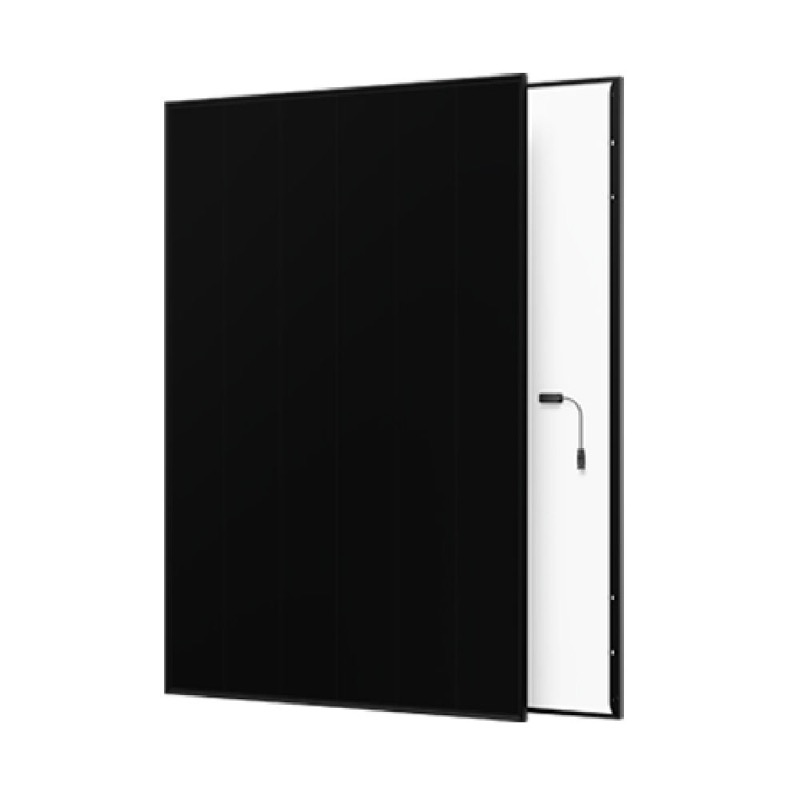
Most solar cells have thin metal strips on the sunny side that collect the current. AIKO's ABC (All Back Contact) cells move all of those contacts to the back. More of the front catches light, which is why AIKO can fit more watts into a panel of the usual size, and the panels look plain black from the street.
The datasheet we checked for the Neostar 3S+54 480–490 W (edition 202601 V3.1) gives a module efficiency of 24.0% to 24.5%. Efficiency matters most when space runs out: on a small roof between a chimney and a roof window, a more efficient panel puts more kilowatt-peak (kWp) on the same area. On a large, unshaded roof you can often reach the same kWp with more panels of a cheaper type, so compare the whole system, not the percentage.
Your yearly electricity use helps us size your solar panel system.
The same datasheet gives a temperature coefficient of −0.26% per °C: the output lost for each degree the cells run above 25 °C. Closer to zero is better, but it describes hot, sunny hours, not a yearly loss; our guide to solar panels in hot weather puts it in UK context.
AIKO also markets its panels as coping better with partial shade. No panel design recovers light that a chimney or tree blocks, so ask for a shade assessment of your roof; our solar panel shading guide explains what a good one looks like.
AIKO's residential range is called Neostar. Its English catalogue lists several generations, sizes and constructions, so read the name in parts.
| Part of the name | What it tells you | What to check |
|---|---|---|
| 2 or 3 (as in 2S, 3S, 3P) | The generation; AIKO labels the 3-series as its third generation | That the datasheet on your quote matches the generation |
| 54, 60 or 48 | The panel format; 54-cell panels are the usual house-roof size, 60-cell panels are larger | How many fit on your roof, and the fixing positions |
| + (as in 3S+54) | A dual-glass version | Weight and the mounting system |
| No + (as in 3S54, 3P54) | A single-glass version | The product warranty, which can differ |
| Power range (e.g. 480–490 W) | The wattage band on that datasheet | The exact wattage you will get |
Example (illustrative): if your roof has room for ten 54-cell panels, ten 460 W panels give 4.6 kWp and ten 480 W panels give 4.8 kWp, 0.2 kWp (about 4%) more on the same area. Pay for it only if the extra output justifies the price difference. A 60-cell panel carries more watts but is bigger, and on a roof with dormers it can cost you a whole row. Ask for a drawn layout with each option; our guide to solar panel sizes explains the dimensions.
A single-glass panel has glass on the front and a polymer sheet on the back. A dual-glass panel has glass on both sides. Dual glass can be sturdier, but it doesn't set the warranty on its own: AIKO gives the single-glass 3S54 and the dual-glass 3S+54 the same 30 years at 480 W and above, while the dual-glass 3P+54 starts at 15. It is also heavier: the 3S+54 480–490 W datasheet we checked gives 24.2 kg for a 1,762 × 1,134 × 30 mm panel. Your installer should check that the roof and the mounting kit can take the load.
Dual-glass panels can also catch some light on the back. The MCS product directory lists AIKO's dual-glass codes under two test conditions: standard (STC), and "BNPI", which adds 135 W/m² of light on the back. AIKO's datasheet rates the 480 W version at 505 W under BNPI. On a sloping roof, with the panel close to dark tiles, little light reaches the back. Make sure your quote and its production estimate use the front-side rating, or ask for a second estimate without any rear-side gain.
AIKO gives each panel a product warranty, against defects in materials and manufacture, and a power warranty, a minimum output over time. The product warranty changes with the model, as AIKO's own English product pages show:
| Neostar model (AIKO product page) | Product warranty | Power warranty |
|---|---|---|
| 3S+54 dual glass, 480–490 W | 30 years | 30 years |
| 3S+54 dual glass, 460–475 W | 25 years | 30 years |
| 3P54 single glass, 470–500 W | 15 years, extendable to 25 | 30 years |
The two 3S+54 rows have almost the same name. The warranty document AIKO links from the 480–490 W page covers its black single- and dual-glass codes (AIKO-A…-MCE54Mb and -MCE54Db) at 480 W and above. It guarantees at least 99% of the rated power after the first year, falling by no more than 0.35% a year, to 88.85% after 30 years. For a 480 W panel that means at least 426 W at year 30 (480 × 0.8885 = 426.5). The power warranty covers the panel's output under test conditions, not your yearly generation.
Four conditions in that document matter to a homeowner:
A 3P54 quote that mentions 25 years should say how the extension from 15 years is obtained and whether it is already included.
AIKO's contact page lists AIKO ENERGY UK CO., LTD, 1539 Stratford Road, Birmingham, as its UK company; Companies House (company 14686935) shows it as active. Its panels are listed in the MCS product directory under Zhejiang Aiko Solar Technology Co., Ltd., including the 480 W 3S+54 dual-glass code (AIKO-A480-MCE54Db), certified from May 2025 to May 2030. Search the directory for the code on your quote.
In Great Britain, the Smart Export Guarantee is paid by licensed electricity suppliers through their own SEG export tariffs, each with its own rate and conditions, and they need the installation to be MCS certified (or to hold an equivalent certification). Northern Ireland has no SEG; export payments there are set by suppliers.
Put an AIKO system on your home through one company that both sells and installs it, and the panels are VAT-free until 31 March 2027; the rate goes to 5% after that unless the relief is extended. Panels you buy on their own, without installation, carry 20% VAT.
AIKO's warranty replaces a faulty panel, but it won't send anyone up a ladder. That falls to your installer, and your contract is with them: under the Consumer Rights Act 2015 the panels they supply should last as long as a reasonable person would expect and the fitting should be done with reasonable care and skill. Ask how long their workmanship guarantee lasts and whether it pays for scaffolding to swap a panel. If they belong to RECC or HIES, confirm it on that code's own register, because an MCS certificate no longer says so.
Our guide to comparing solar quotes goes through the rest of a quote line by line.
AIKO makes most sense where space is short or appearance matters, and your quote shows the extra efficiency buying you more kWp or generation than another panel would. On a large, unshaded roof, a cheaper panel that reaches the same output may be the better buy unless AIKO's code carries the longer warranty.
For another back-contact option, compare LONGi; for TOPCon panels, compare JA Solar or JinkoSolar. Ask each installer for the same roof layout and production method, then weigh them up with our guide to the best solar panels.
AIKO makes back-contact panels with high efficiency figures: 24.0% to 24.5% on the 3S+54 480–490 W datasheet we checked. It has a UK company, and its panels are listed in the MCS product directory. Whether it suits you depends on the model, its warranty and the installed price on your quote.
AIKO's power warranty runs for 30 years on the Neostar models above, with at least 88.85% of rated power guaranteed at year 30 on the 480 W and higher 3S+54 panels. A warranty is a minimum, not a lifespan; our guide to how long solar panels last explains what wears out and when.
AIKO's warranties are issued by Zhejiang Aiko Solar Technology Co., Ltd., the manufacturer named in the MCS product directory. Its UK company is AIKO ENERGY UK CO., LTD in Birmingham.
No. AIKO's own pages give 30, 25 or 15 years (extendable to 25) depending on the model and wattage band, so check the warranty document for the code on your quote.
Tell us about your home and we’ll look for an MCS-certified installer who can quote.
 No cost and no obligation
MCS-certified installers
One short request
We currently receive no payment from installers, or from anyone else, for quote requests.
 Get quotes: AIKO
We currently receive no payment from installers, or from anyone else, for quote requests.