
Reading time: 15 min
Solar battery storage: how it works and when it pays
How home solar batteries work in the UK, what time-of-use tariffs add, worked examples with losses and export given up, and what to check before you buy.
Read more
Sungrow sells string inverters, SH hybrid inverters and SBR batteries in the UK. Which one suits you depends on the exact model pair, the usable capacity and whether you want backup.
 China
China
 8,000+ employees
 Founded 1997
Compare the specifications and warranties of the exact model.
Sungrow makes sense if you want the inverter, battery and app designed together, from a maker with its own UK office. Its UK range includes SG string inverters, SH hybrid inverters that also run a battery, and SBR battery towers. They answer different needs, so the brand name on a quote tells you little. Ask for the full model code of each part, an estimate based on your own usage, and a wiring plan if you expect power during a cut.
Sungrow Power UK Ltd was set up in 2014 and is based in Milton Keynes; Sungrow says it has 90 staff across the UK and Ireland. UK wholesalers such as Midsummer Wholesale sell Sungrow battery systems.
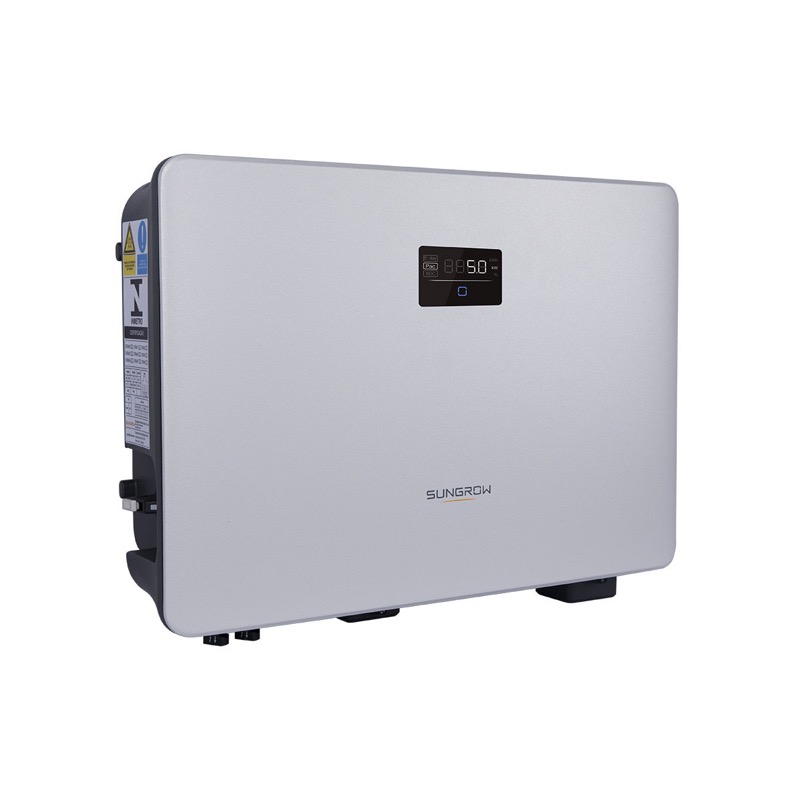
The inverter turns the direct current (DC) from your panels into the alternating current (AC) your home uses. A string inverter, such as Sungrow's SG range, does only that. A hybrid, such as the SH-RS, also charges and discharges a battery and decides where the power goes: into the house, the battery or the grid. The iSolarCloud app then shows those flows, as long as the meter and internet link are fitted correctly.
Your yearly electricity use helps us size your solar panel system.
| Part | What it does | What to ask |
|---|---|---|
| SG string inverter | Converts solar power only | How would a battery be added later, if you want one? |
| SH-RS hybrid (single-phase) | Converts solar power and runs a compatible battery | Which model suits my supply and G98 or G99? |
| SBR battery | Stores energy on the DC side | How many usable kWh, and how much power with this inverter? |
| Meter and backup wiring | Measures flows; keeps chosen circuits on in a cut | Which parts and consumer-unit work are included? |
"Sungrow 6 kW" on a quote is not enough: it doesn't say which family, how many panel inputs or whether a battery can be added. The inverter's kW rating also isn't the size of your solar array. On a simple, unshaded roof a string design works well; on a roof with several faces, compare it with other layouts before deciding. No inverter recovers output lost to a badly placed panel.
G98 or G99. In Great Britain, the G98 route covers up to 3.68 kW on a single-phase supply: the installer fits the system and notifies the network operator within 28 days (30 days in Northern Ireland under G98/NI). Sungrow's UK datasheet for the SH-RS (version 16) rates the SH3.6RS at 3,680 W and 16 A, which fits that limit, and lists G98 and G99 among its grid standards. On the ENA type-test register (checked 24 September 2026), the SH3.0RS and SH3.6RS have Compliant G98 records for Great Britain. The SH4.0RS, SH5.0RS and SH6.0RS are above it, so your installer must apply under G99 and get the network operator's approval before connecting, sometimes with an export limit.
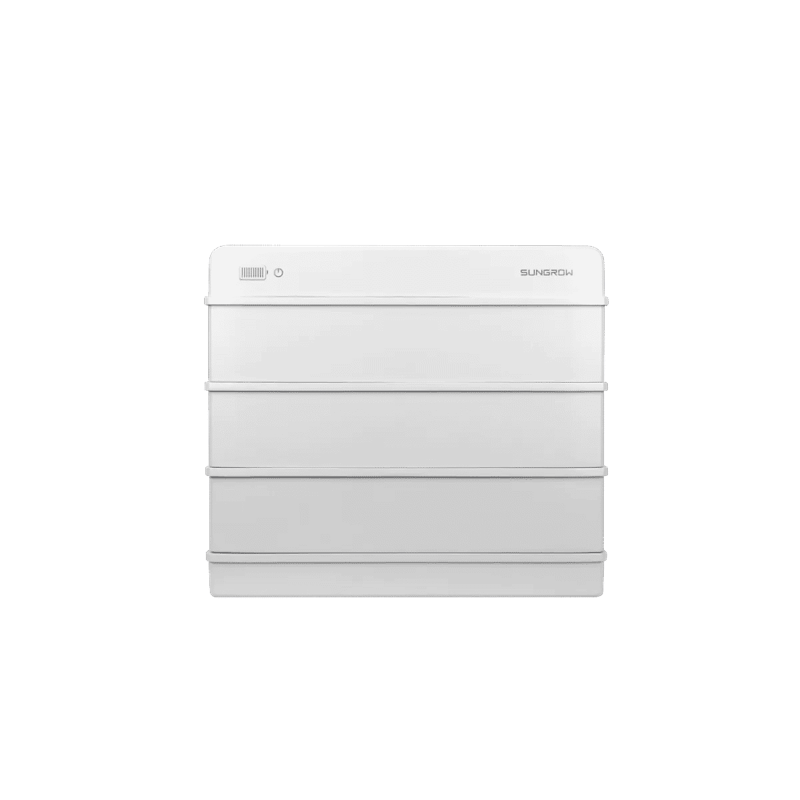
The SBR is a high-voltage lithium iron phosphate (LFP) battery built from 3.2 kWh modules stacked in one tower. The UK datasheet we checked (version 4, 2024) lists seven sizes:
| SBR tower | Usable energy | Modules | Weight |
|---|---|---|---|
| SBR064 | 6.4 kWh | 2 | 89 kg |
| SBR096 | 9.6 kWh | 3 | 114 kg |
| SBR128 | 12.8 kWh | 4 | 147 kg |
| SBR160 | 16.0 kWh | 5 | 180 kg |
| SBR192 to SBR256 | 19.2 to 25.6 kWh | 6 to 8 | 213 to 279 kg |
The SBR064 comes with an empty third module, which adds no capacity. The usable figures are measured at 25°C with a full charge and discharge, so you'll get a little less at the socket after conversion losses and any reserve you keep for power cuts.
Capacity answers "for how long?"; power answers "how much at once?". The datasheet gives 30 A continuous current (less for the SBR064 on some three-phase inverters), and the SH-RS datasheet caps battery charging and discharging at 6,600 W. So ask for the power of your exact inverter-and-battery pair, not a battery figure on its own.
Example (illustrative): a household using about 2,500 kWh a year might use 5 kWh after sunset. On a day with only 3 kWh of spare solar, an SBR096 can shift just those 3 kWh; a bigger tower can't fill itself. In winter, when spare solar is low, a large battery mostly waits. Homes with an electric car, a heat pump or a cheap overnight tariff can fill a bigger battery from the grid at night, which is where extra capacity earns its keep. Our guides to solar battery storage and what size battery you need go through the sums.
The SH-RS has a backup output. Its UK datasheet gives a switchover time under 10 milliseconds and a backup rating equal to the inverter's size: 3,000 W on the SH3.0RS up to 6,000 W on the SH6.0RS, with a short 10-second peak of 8,400 VA. That isn't the same as the whole house staying on. When the grid fails, your home has to be disconnected from it, and only the circuits wired to the backup output keep power. Our guide to whether solar panels work in a power cut explains why.
Say you want to keep the fridge, some lights, broadband and a desk socket on. Your installer should add up what those draw together, including the surge when the fridge starts. An electric shower, oven or heat pump is a different project. The battery's kWh set roughly how long backup lasts; the kW rating, wiring and protection set what can run. Ask too whether the panels can recharge the battery during a long cut with the design you're offered.
Backup has a running cost: any charge you reserve for a power cut isn't there to cut your evening bills. Ask to see the reserve setting and a switchover test at handover; don't work on the consumer unit yourself.
An SBR tower stands on the floor and, per its datasheet, is rated IP55 for indoor or outdoor installation. It needs clearances, a solid floor and access for servicing, as set out in the manual supplied with it. A spare corner of the garage isn't enough if the cables would be too long or a later extra module wouldn't fit. Ask for a layout drawing showing the inverter, battery, isolators and meter.
At commissioning, ask for your own iSolarCloud owner account. A solar output graph alone doesn't show that self-consumption or the battery are working: check that the app also shows flows to the house, the battery and the grid. An installer who keeps the only login makes faults harder to diagnose and changing installer harder.
If you already have panels, a Sungrow hybrid isn't the only way to add storage. Compare replacing your inverter with an AC-coupled battery that leaves it in place, and count the value and warranty left on the old inverter.
Sungrow's warranty terms vary by product and edition. The most recent warranty covering the UK that we could read is Sungrow's distribution warranty, revision 2.5, for products sold from 1 October 2021. It gives:
That throughput limit matters. For an SBR096, the 2021 edition's table pairs at least 80% state of health with 25.53 MWh of throughput, and 60% with 40.32 MWh. 25.53 MWh is about 2,660 full cycles (25,530 ÷ 9.6), or around 0.7 a day over ten years. That suits normal solar use; a battery cycled hard on a time-of-use tariff could reach the limit sooner.
Sungrow may have updated its terms since. Before you sign, ask the installer for the warranty document that applies to your serial numbers and installation date, with the capacity threshold, throughput in MWh and exclusions for your tower. Keep the invoice, serial numbers, commissioning report and app access, because the warranty runs from the date of sale. The 2021 edition lets the warranty pass to a new owner as long as the equipment stays where it was first installed.
Ask for two versions: panels and inverter only, then the same system with an SBR sized from your usage. List the hardware, meter, any backup wiring, consumer-unit work, commissioning and the G98 or G99 paperwork. The difference between the two totals, set against the energy you'd really shift each year, shows what the battery is worth to you.
A Sungrow hybrid and SBR tower supplied and fitted together by your installer are zero-rated for VAT until 31 March 2027, and 5% after that unless the relief is extended; bought without installation, the same kit carries 20%. In Great Britain, a Sungrow system's export is paid by an energy supplier under its own Smart Export Guarantee tariff, at its rates and conditions, and only if the installation is MCS-certified or holds an equivalent certification; Northern Ireland has no SEG. MCS lists panels, not inverters or batteries, so check the installer's certificate.
Sungrow's warranty covers parts; your contract is with the installer, and under the Consumer Rights Act 2015 they must put right goods that aren't of satisfactory quality and installation work not done with reasonable care and skill. If you're asked for a deposit, check whether the installer belongs to RECC: its members can't take a deposit of more than 25% and must back their workmanship warranty with insurance. MCS certification no longer means membership, so check the RECC or HIES register yourself. Our guide to comparing solar quotes has the line-by-line checklist, and choosing an installer covers vetting the company.
Our view: Sungrow suits buyers who want a hybrid inverter and battery from one maker with a UK office behind it, and single-phase homes that want to stay under G98 with the SH3.0RS or SH3.6RS. Compare it with a quote for the same usable kWh and backup, such as a GoodWe hybrid and Lynx battery, and get the current warranty edition in writing before you sign.
It depends on what you use after dark and how much spare solar you have to fill it. Its 6.4 kWh is measured at the battery; allow for losses, any backup reserve and the season before deciding.
No. It needs a compatible hybrid, with the right battery voltage range, communication and software. An SG string inverter doesn't run it. Ask for the exact pairing in writing.
The 2021 UK-covering edition gives 10 years on SH-RS inverters and on SBR batteries, the battery part limited by throughput. Accessories have 5 years. Ask for the current document for your serial numbers.
In Great Britain, on a single-phase supply, the SH3.0RS (3,000 W) and SH3.6RS (3,680 W, 16 A). The larger SH-RS models need a G99 application.
Tell us about your home and we’ll look for an MCS-certified installer who can quote.
 No cost and no obligation
MCS-certified installers
One short request
We currently receive no payment from installers, or from anyone else, for quote requests.
 Get quotes: Sungrow
We currently receive no payment from installers, or from anyone else, for quote requests.