
Reading time: 10 min
How many solar panels do I need?
Panel counts for typical UK homes by location, the sizing formula with worked examples, and why more panels mostly means more exports.
Read more
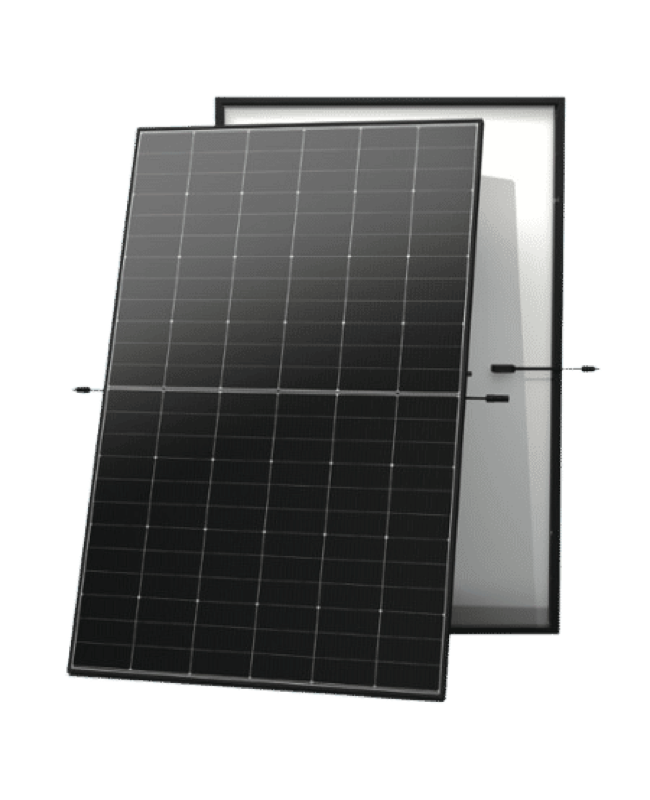
Trina's Vertex S+ range gives you black-frame, all-black and bifacial dual-glass panels for house roofs. Which one suits you depends on your roof, and the warranty depends on the exact code.
 China
China
 40,000+ employees
 Founded 1997
Compare the specifications and warranties of the exact model.
Trina Solar deserves a place on your shortlist if you want a dual-glass TOPCon panel for a house roof: its Vertex S+ range comes with a black frame, fully black or bifacial, and all three are listed in the MCS product directory. Check the warranty, though. Trina's house-panel datasheets say "up to 25 years" on the product, but its global warranty gives the Vertex S+ panels 15 years. A separate supplement raises two of them to 25 years when installed in Europe. So the code on your quote decides which you get.
| In Trina's favour | Check before you sign |
|---|---|
| Three house-roof looks from one range, useful on a visible roof | The exact TSM code and the power class you'll actually get |
| Datasheets that separate build and size clearly | The datasheet edition and the warranty documents for your code |
| Several panel sizes, including larger ones for bigger roofs | The roof layout: the biggest panel isn't always the one that fits best |
| A written claims process with a European service centre | Who in the UK raises a claim and pays for access |
Your yearly electricity use helps us size your solar panel system.
Trina suits someone comparing two or three priced layouts who wants to weigh looks, the power that fits and total cost. On a roof with dormers, chimneys or shade, the quality of the design matters more than a few watts on a datasheet.
Trina sells four Vertex S+ panels on its European rooftop site. The table uses the English datasheets we checked; later editions can raise the power classes, so ask for the datasheet that matches your quote.
| Code | Build | Power (datasheet) | What it means on your roof |
|---|---|---|---|
| TSM-NEG9R.28 | Black frame, dual glass, monofacial | 430–460 W (2024 C); 450–475 W (2026 A) | A plain house panel; no rear-side gain to count |
| TSM-NEG9R.25 | All black, dual glass, monofacial | 430–455 W (2025 A) | The tidiest look on a visible roof; compare total kWp that fits |
| TSM-NEG9RC.27 | "Clear black", dual glass, bifacial | 425–450 W (2024 A) | The back can add output if light reaches it; little on a tiled roof |
| TSM-NEG18R.28 | Larger format (1,961 mm long) | 485–510 W (2024 C) | Aimed at commercial roofs; more watts per panel, fewer panels fit |
Not every power class in the table has a current MCS certificate: the NEG9R.28 up to 445 W, the NEG9R.25 up to 435 W and the 485 W NEG18R.28 are listed only under the grace period explained below.
The MCS directory also lists a TSM-NEG9R.28U, a variant of the black-frame panel, but only under a grace period: it lost its MCS certificate on 1 August 2026, and MCS installers can fit existing stock only until 1 February 2027. If your quote shows it, ask which datasheet applies and when the panels will be fitted. Trina's global warranty names the .28U alongside the .28.
Ask for the full TSM code, the wattage, the dated datasheet and a clause saying what happens if the installer wants to substitute a different panel. A different suffix can change the size, the build and the warranty.
All four panels use N-type TOPCon cells and glass on both sides. Those are panel features, not a yearly output promise. Efficiency describes the panel under test conditions; your kilowatt-hours also depend on your roof's direction and pitch, shading, ventilation behind the panels and system losses. Compare production estimates made on the same assumptions for every quote. Our shading guide explains why a small shadow can cost more than a few watts of panel rating.
The finish is a more tangible choice. Facing the street, the all-black NEG9R.25 may look better; elsewhere the black-frame NEG9R.28 may give as much power for less. The bifacial NEG9RC.27 datasheet quotes bifaciality up to 85%, but that only turns into energy when light reaches the back, for example on a frame over a pale flat roof. On a pitched roof with the panels close to the tiles, ask for an estimate without any bifacial bonus.
Dual glass doesn't replace a structural check: the fixings must suit the exact model and the roof must carry the whole system.
Start from the usable roof area and ask for two layouts. On a roof broken up by windows and vents, the panel that fits around the obstacles can beat a more powerful one.
Example (illustrative, not a forecast): twelve 455 W panels make 5.46 kWp and twelve 450 W panels make 5.40 kWp. That 60 W gap means little if one layout puts panels in shade. If one format lets you fit a thirteenth panel in good light, the gap matters more. Ask for both layouts priced with the same losses. Our guide to how many solar panels you need explains the sizing.
The datasheets we checked promise "up to 25 years" on the product (the NEG18R.28 sheet says "25 years") and 30 years on power. The two cover different things: the product warranty covers defects in materials and manufacture; the power warranty promises a minimum output, measured under test conditions. Neither guarantees your bill, each year's generation or the rest of the installation.
The documents behind those headlines work in layers:
| Document | What it says |
|---|---|
| Global Limited Warranty (revision AA, products delivered from 1 July 2025) | Covers every country except Germany and Turkey. Puts NEG9R.28, NEG9R.28U, NEG9R.25, NEG9RC.27 and NEG18R.28 in its 15-year product warranty class |
| Same document, power warranty | For these panels: at most 1% loss in year one, 0.4% a year after, at least 87.4% at year 30 |
| Vertex S+ supplement | Raises NEG9R.28 and NEG9RC.27 to 25 years if delivered after 1 January 2023 and installed in Europe |
The NEG9R.25 and NEG18R.28 aren't named in the supplement we read, so for those ask the installer for the document that gives them 25 years, or assume 15. The supplement doesn't define "Europe"; ask for written confirmation that a UK installation qualifies.
Four terms in the global warranty matter at home:
Our guide to how long solar panels last puts the power warranty in context.
Trina panels reach UK installers through wholesalers; Midsummer Wholesale, for example, lists a Trina range. The MCS product directory lists Vertex S+ panels under Trina Solar Co., Ltd. Current certificates, running from 30 March 2026, cover the NEG9R.28 from 450 W to 475 W, the NEG9R.25 from 440 W to 465 W, the NEG9RC.27 from 425 W to 450 W and the NEG18R.28 from 490 W to 525 W (checked 24 September 2026). Lower power classes, and every NEG9R.28U, appear only with a "grace period" label: those panels lost MCS certification on 1 August 2026, and installers may fit existing stock in MCS-certified installations only until 1 February 2027. An MCS installer has to use listed panels, so search the directory for the exact code and wattage on your quote.
Trina's service centre for Europe is Trina Solar (Schweiz) AG in Switzerland. In practice your installer will be your first contact, so ask them in writing who spots the problem, who files the claim with Trina, and who pays for the callout and scaffolding.
Trina isn't a must-have or a brand to avoid. If you're also quoted JinkoSolar or JA Solar, compare panels of a similar size on the same roof plan. A back-contact panel from AIKO may change the sums on a small roof, but the total kWp you can fit and the installed price decide it. Don't assume another brand's warranty, or another Trina code's, applies to yours.
To compare solar quotes, line up at least:
Installed in your home by the company that supplies them, panels are zero-rated for VAT until 31 March 2027, then 5% unless the relief is extended; bought without installation they carry 20%. Our solar panel cost guide shows typical installed prices. In Great Britain, suppliers buy your exported electricity through their own Smart Export Guarantee tariffs, at their own rates and conditions, once the installation has MCS certification or an equivalent; there's no SEG in Northern Ireland.
If you sign at home after a sales visit, or online or by phone, the Consumer Contracts Regulations 2013 normally let you cancel from signing until 14 days after the panels are delivered, and up to 12 months longer if the installer didn't tell you about that right. After fitting, your claim for a faulty panel or a poor job lies against the installer under the Consumer Rights Act 2015, whatever Trina decides about its own warranty. An MCS certificate won't tell you whether the installer belongs to a consumer code such as RECC, which requires an insurance-backed workmanship warranty of at least two years; ask for the membership number and check it. Our guide to choosing a solar installer covers the rest.
A well-documented Trina quote can beat an offer with a better-looking datasheet but a vague model and support. Our best solar panels guide compares brands on the same basis.
Its Vertex S+ panels are credible options for a house roof. For your home, it depends on the exact code, how many panels fit, the installed price, the warranty documents and the installer.
No. The NEG9RC.27 is bifacial. The NEG9R.28 and NEG9R.25 are monofacial even though they have glass on the back.
No. The global warranty gives these panels 15 years, and the Vertex S+ supplement raises the NEG9R.28 and NEG9RC.27 to 25 years when delivered after 1 January 2023 and installed in Europe. Ask for the documents for your code.
Trina's global warranty asks for claims within two months of finding the problem. Tell your installer straight away and keep the invoice and serial numbers.
Tell us about your home and we’ll look for an MCS-certified installer who can quote.
 No cost and no obligation
MCS-certified installers
One short request
We currently receive no payment from installers, or from anyone else, for quote requests.
 Get quotes: Trina Solar
We currently receive no payment from installers, or from anyone else, for quote requests.